
By Taylor Adams Cogan
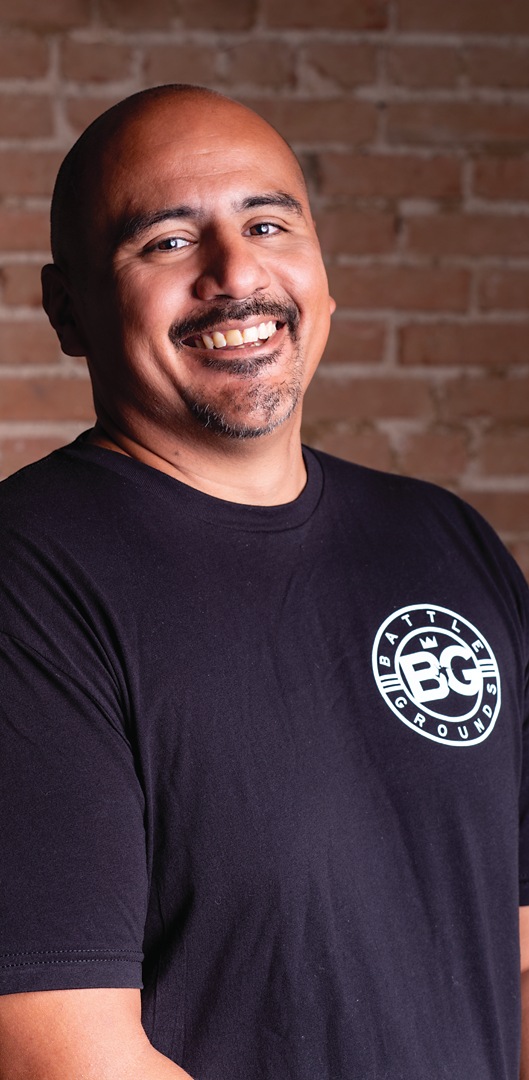
Joel Salazar came up in the Dallas dance and music scene because of his talent and work, but it’s his dedication to guiding others to do the same that keeps him thriving today.
In the late 1990s and early 2000s, Salazar was deep in Dallas’ underground dance music scene: drum and bass, warehouse parties, late-night raves where word of mouth mattered more than flyers. He toured some, lived overseas for a bit, and, like a lot of artists, learned early on how uneven the music industry could be.
“There were times when set times wouldn’t be put up. Pay wouldn’t be discussed,” Joel said. “All these little things that make you feel like you’re not being respected.”
Instead of walking away from the scene, he chose to build something better inside it.
Joel began focusing less on performing and more on creating platforms — shows and spaces where artists were treated honestly, paid clearly, and supported by organizers who did what they said they would do. Alongside a small group of collaborators, he co-founded Poor Vida Productions, quickly shifting from dance music into hip-hop through rap tours, DJ contests, and battles throughout Dallas.
“We did a bunch of stuff together. For about four or five years, we put out an album, ran a label, and did some tours with some artists that were signed to us,” he says. “Then, over that time, it progressed, and everybody kind of went their own separate ways.”
That was about 15 years ago, when Joel had the opportunity to go out on his own with Too Fresh Productions.
“It was a hard start over,” he said. “I had to make the flyer, build the website, book the DJ, host the event — all of it.”
What could have been a setback became a crash course in creative survival. Salazar learned to be relentlessly multi-faceted, building skills that extended beyond music and into promotion, public speaking, logistics, and relationship-building.
“That’s something I really encourage younger artists to do,” he said, “find what you naturally progress into through your art, and then complement that with the real-world side of work.”
More than anything, he built a reputation for honesty.
“I just found a lot of different resources and outlets, and just kept true to people with my word. If I had to pay somebody, I paid them. If I didn’t have it, it was like ‘Hey, this is a showcase. This is what it is,’” he says. “But I was always very upfront and honest with everybody, and I think that’s what has allowed me to maintain and establish relationships over the years, which has allowed me to be a little bit more creative and flexible.”
That consistency paid off. Over time, he developed long-standing relationships with venues and artists across the city, allowing him to move fluidly between scenes and roles. Today, he describes his career as having built “three or four different ecosystems” — spanning music, street dance, and cultural programming, which, of course, has kept him returning to Deep Ellum.
In fact, his love for the neighborhood deepened while working on We From Dallas, a documentary on the history of Dallas hip-hop that premiered at the Dallas International Film Festival in 2014. Through more than 200 interviews and research, Joel came to see just how foundational Deep Ellum has been — a place that generations of artists have passed through, learned from, and been shaped by.
“You really learn about the impact of Deep Ellum, and how much it’s meant to everybody,” he says of the documentary. “It’s kind of been a foundation spot for everybody. And it was for me: there and Lower Greenville. Those are the two main strips of Dallas culture that I kind of grew up in.”
Joel’s still around Deep Ellum, from hosting Fresh 45s at Ruins to running a DJ night that has rotated through the neighborhood and Lower Greenville since 2018, earning multiple Dallas Observer Best DJ Party awards. The lineup has evolved over the years, but the spirit hasn’t — a revolving door of DJs, records, and community.
He’s also ingrained in street dance culture through Battle Grounds, which began at Club Dada, moved through Independent Bar and Kitchen and CheapSteaks, and has now found a long-term home at Ruins. Beyond that, Salazar has played and hosted events across Deep Ellum — from Off the Record and Braindead Brewing to Armoury D.E. and Deep Ellum Art Company — adapting as venues come and go.
Looking ahead, Joel hopes the city finds a way to better integrate culture into planning and development: not as an afterthought, but as a guiding force.
“I really hope there’s some type of cohesiveness within the city arts, having the curators of culture be involved within the neighborhood,” he says. “I understand development and things progress over time, but I really hope that the neighborhood never loses that touch of the people that are there creating all the time that have been there.”
He believes Deep Ellum’s future depends on balance: honoring nostalgia without freezing in it, and embracing innovation without erasing what made the neighborhood matter in the first place.
“It’s the older heads and the younger people going out and trying to find that balance and not it tilting one way or another, but still keeping the charm of Deep Ellum,” he says. “But not losing sight of what it is and not changing it so much. Don’t get me wrong, I’m all about updating and doing stuff; at the same time, not losing sight of what it is.”
That same philosophy also shapes how Joel mentors others. Over the years, he’s quietly helped guide younger creatives with booking shows, running doors, offering advice, and then stepping back once they find their footing. Recently, he worked closely with street dancer Hailey Summers, who spearheaded a nine-month, city-funded dance program.
“I guided her; I got her in front of the room with everybody,” he says. “It’s kind of funny. I found myself working with younger people who want to get involved. I’m just there to help guide them and be like, ‘Hey, don’t do that, or you might want to think about this route.’”
With projects now extending into Garland and Mesquite, Salazar sees his role clearly, as someone who opens doors and then steps aside for others.
“It’s about each one, teach one,” he said.
For Joel, Deep Ellum has never been about ownership or legacy in name alone. It’s been about showing up, doing the work, and building systems that last while quietly shaping a neighborhood by making sure the people inside it are treated right.
