
By Taylor Adams Cogan
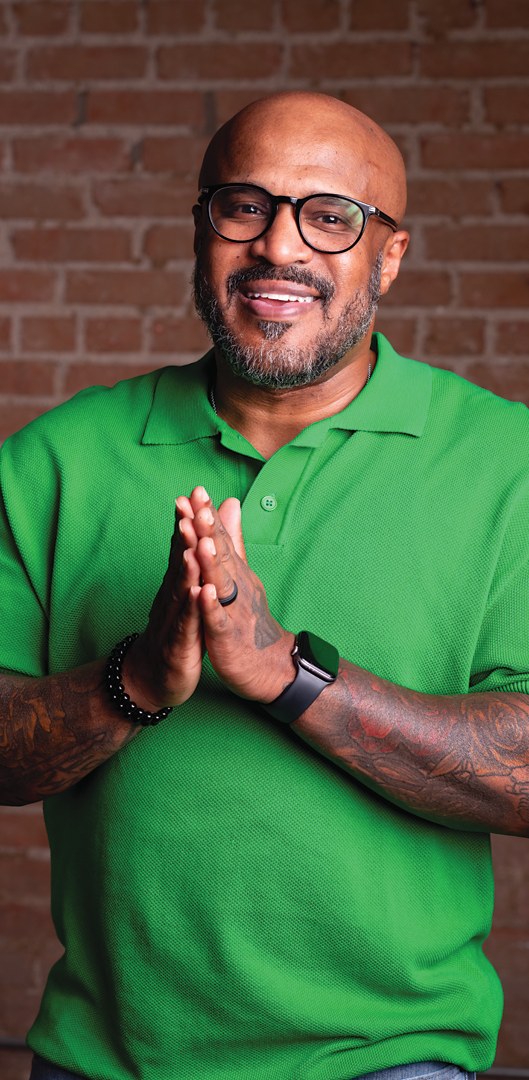
Gino “LockJohnson” Iglehart has been part of Deep Ellum for more than three decades; long enough to remember watching legends through a window because he wasn’t old enough to walk through the door.
“I played my first gig in Deep Ellum when I was 16,” Gino, now 50, says, “so I’ve been around a long time. I’ve seen it go through different phases and trends: dark times, very positive times. I guess I’ve always been a voice, even when I didn’t know I was one.”
Over the years, that voice evolved into something larger, an ambassador for the scene, a connector, a bandleader, and a behind-the-scenes force helping create spaces where musicians and audiences can meet.
Gino grew up a church kid and a pastor’s son, and his earliest performances were rooted in gospel. One of his first gigs in Deep Ellum took place at a teenage Christian venue before The Door settled into its later home. But just as influential were the nights he and his (underage) friends spent outside the original Sambuca on Elm Street.
“Because we couldn’t get in, we’d just go sit at the window and watch legends like Shelley Carroll, Marchel Ivery, Buddy Mohamed, Roger Boykin,” he says. “I was like, hey, these might be my boys. But yeah, we’d go sit at that window and just watch. And it was what I thought I wanted to do for the rest of my life.”
Drums would become Gino’s primary instrument, but more significantly, he was learning what a life in music could look like.
Even early on, Gino describes himself as a “chameleon.” Music was central, but not exclusive. He played soccer, attended college in Louisiana, and tried to figure out who he was outside of Dallas before eventually returning home.
“I came back and got heavy into the music scene again, starting on the church side because that’s my roots,” he says. “I linked up with the late, great Sean Martin. That’s my musical family.”
Finding his own sound took time. Today, he calls it “populistic soul” — a blend of R&B, gospel, jazz, rock, country, Latin, and pop.
“I’ve been fortunate and blessed to be able to adapt to whatever style musically,” he says. “And that also translated into how I embrace people.”
For Gino, music and humanity are inseparable.
“The energy I give to music is the energy I give to people,” he says. “We should never see each other in a negative way, because you’re a thing of beauty. Somebody just may not have told you yet.”
Deep Ellum became the classroom where that philosophy took shape. Early on, the Main Street internet café gave him room to experiment.
“They were one of the first venues to let me just try anything,” he says. “I didn’t know I was curating events. I thought I was just getting people together to play.”
From there, Gino’s path wound through Lemon Bar, Trees, The Door, Prophet Bar, Sambuca, Curtain Club, Liquid Lounge, and more — each stop adding to his understanding of how scenes grow and survive.
Club 369 holds particular significance: Owned by the late Bishop Omar Jawar, it was the first venue Gino ever managed.
“As fate would have it, that venue is what is now the main stage of The Freeman,” he says. “So, when I later became general manager there, I was basically coming back home.”
Another turning point came around 2016 at Louie Louie’s Piano Bar, where Gino started a Sunday show with his group, Kirk Thurmond and the Millennials.
“I wanted us to have a place to rehearse,” he says. “And I thought I could probably get us paid for it too.”
The idea grew into a weekly event that regularly drew hundreds of people and led to Gino joining Louie Louie’s front office, curating additional programming. His work there eventually caught the attention of John Jay Myers at The Freeman, leading to his hiring as general manager.
Today, Gino balances life as a full-time stay-at-home dad with an expansive creative and business portfolio. He co-owns The Alley Music House in Addison, located across from the Addison Improv, with a mission of “bringing soul to the ’burbs.” He continues writing, arranging, producing, performing, managing artists, and running Playground Recordings, which recently released new music from Tim Starling. His band, Raphael & Ivory Jean, is also signed to the label.
“I finally put everything I learned into one bag,” he says. “I started acknowledging that these are all the things I do.”
Deep Ellum remains central to how he sees the world — even as he believes it’s necessary to grow beyond it.
“No matter how dark or bleak someone may try to paint Deep Ellum, it’s really a beautiful place,” he says. “If you’re not deep enough, you won’t get all its nuances and quirks. That’s what makes it special. But you’ve got to grow beyond it, then come back with something to contribute.”
After more than 30 years tied to Deep Ellum’s stages and sidewalks, Gino carries both gratitude and complexity about his journey. His departure from The Freeman wasn’t easy, but he sees it as necessary.
“I knew it was time to take what I got from here and show everybody outside of here how beautiful this place is,” he says.
And in many ways, that may be Gino “LockJohnson” Iglehart’s lasting contribution to Deep Ellum: not just the music he’s played or the venues he’s shaped, but the belief that art, at its best, teaches us how to see one another with more care.
