
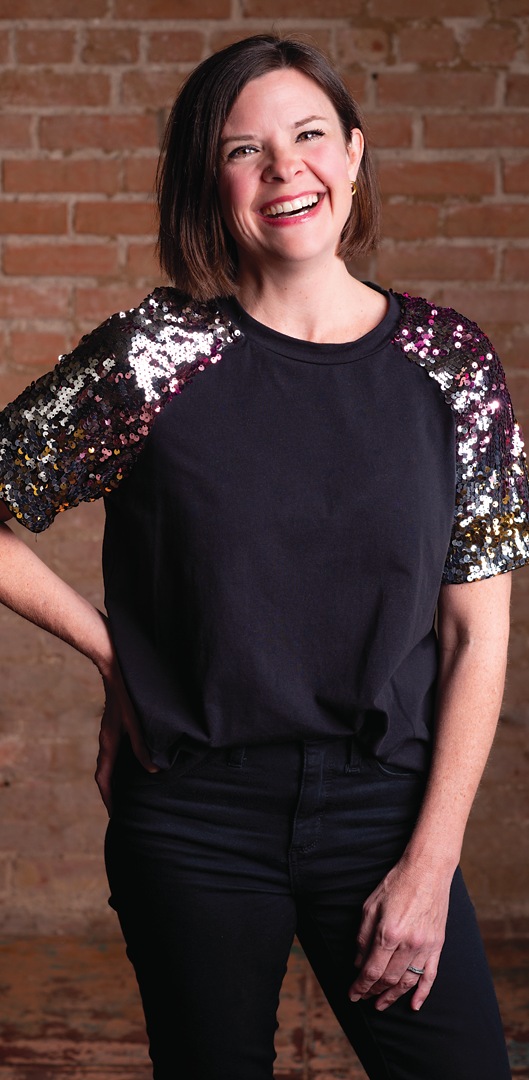
By Taylor Adams Cogan
Kari LaRue didn’t plan to run a live music venue.
She grew up in Liberty, Texas — east of Houston, not far from Beaumont — and followed a straightforward path to Dallas for school. After graduating from Southern Methodist University, she landed a teaching position at the Winston School, where she also met her future husband, John.
Music venues, touring bands, and art-bar shenanigans weren’t on their radars when they married in 2006. Six years later, they rented an RV and drove to Tennessee for their first music festival: Bonnaroo. About 96 miles from their destination, something beneath the carriage broke; the RV ran over it, got a flat tire, and the couple was stuck for six hours until a tow truck arrived in pouring rain. But it ended up being worth it.
“That was the first time I had seen Phish, they performed it’s a whole experience,” she says. “It was a whole adventure just getting there,” she says. “But then we had the best time.”
On the drive home, Kari looked more into the jam band and found that Phish was playing a three-night run in Commerce City, Colorado, over John’s birthday weekend. She didn’t ask. She just bought the tickets.
That was the beginning. They’d go back to Bonnaroo and other festivals across the country that drew them. Somewhere between dusty fields and late-night sets, they started wondering how they could more easily experience what was pulling them to festivals.
“Festivals are special because they are temporary, but we thought about making a festival vibe 24/7: We wondered if that was even possible,” Kari said.
The answer would become Deep Ellum Art Co.
The couple was already in the throes of opening a restaurant when a friend tipped them off to an open industrial space at 3200 Commerce Street in Deep Ellum. It wasn’t built for cooking or serving food. In fact, it wasn’t built for much of anything at all.
“He brought me to see it and everything. It was a rough shell at the time, and then there’s a group of guys that own the building, and they were like, ‘We could see a music venue with some cool art, do you want to go for it?’” she says. “We took a weekend to think about it. But yeah, we thought that would be really cool to do here.”
The couple founded the effort in 2015, and the doors to the small venue opened in 2017, welcoming countless bands, walls filled with art, reasonably priced drinks, and a yard for fresh air. You go to a concert, maybe buy local art, and it’s easy to think: All of this just makes sense. Especially for Deep Ellum.
A few years later, all venues would be unable to escape the effects of the COVID-19 pandemic.
Like most independent venues, Art Co. cycled through open-and-close orders, distancing rules, and shrinking crowds. After their third anniversary in September 2020, they made the hardest decision yet: to trim down to the bare bones. Kari had taken over managing the gallery herself.
“It’s something I never envisioned myself doing. I have a psychology degree, not art history. I love and appreciate art,” she says. “I think Art Co. fills a really specific niche, given that we’re a live music and art bar. I would say most shows, I think we have repeat customers.”
If they book a band that has never played the venue, maybe 50% of the attendance has never been to Art Co. before: They’re going for a band and getting a surprise of visual art. The two art forms play off each other, a passion between the couple, and an experience that keeps people coming back.
“John does the lion’s share of the booking,” she says. “Once a show is confirmed, I handle the social, pre-sales, and the website. Ninety percent of the time when his phone rings, it’s business.”
Today, he books nearly everything alone — a hefty responsibility for the destination.
“You wouldn’t think a 500-person venue would be so demanding,” she says. “But it takes an enormous amount of work to book the right shows for the space — and shows that will actually sell.”
What makes Art Co. different is its dual identity. You walk in and see the stage first. Then, off to the side, the gallery reveals itself — full of work you may have otherwise never seen.
Some people collect band T-shirts. Others frame posters. At Art Co., fans can leave with an original piece of art from the gallery as a tangible reminder of the night.
“It becomes a tangible memory of the night,” Kari says.
The venue has also become a launchpad. Early in their careers, they hosted Billy Strings, then watched him climb, tour by tour, into sold-out headlines. Other familiar names followed — Oliver Tree and Conan Gray, among them.
“That’s the magic of small rooms,” she says. “Everybody starts somewhere. You don’t open your career at the American Airlines Center.”
Venues like Art Co. are essential rungs on music’s ladder — the places where artists figure out who they are in front of real audiences. While they learn from live-music fans in venues, the industry helps keep neighborhoods like Deep Ellum vibrant at the street level.
If she’s not at work or at home, she’s almost nowhere else. Deep Ellum has become her daily rhythm.
“This neighborhood has always been a hub,” she says. “It was one of the first desegregated music spaces in Dallas — everybody making music together. That history matters.”
Deep Ellum’s densely packed with food, art, bars, stages, record stores, and something happening every night. Kari believes protecting that creative closeness is what keeps the neighborhood from becoming just another entertainment district.
Keeping places like Art Co. alive matters — not just for audiences, but for the artists still finding their sound. Between pandemics, construction, and shifting ticket sales, survival is never guaranteed, meaning it’s on everyone to make it out when they can. So, go: Pick a band that sounds cool, hear something new to you, have a good time, and support your local venues.
Art Co. was born from a festival dream: take the temporary magic of weekends in fields and try to stretch it across an ordinary calendar.
A decade in, that dream survives — not because it’s easy, but because a small, indefatigable team refuses to let it disappear.
“It’s something I never envisioned myself doing,” Kari says. “But we’ve found this really specific niche — and as long as we can keep filling this room with music and art, we’re doing exactly what we’re supposed to be doing.”
